
By Home Tweakz Team | Last Updated: June 22, 2026
Introduction
A bare floor does more damage to a room than most homeowners realize. Without something to anchor it, furniture floats, noise bounces off hard surfaces, and the space never feels quite finished. Modern area rugs solve all three problems at once — and they do it with style.
Unlike older rug designs that leaned on ornate borders and intricate motifs, today’s options favor clean geometry, muted palettes, and materials that actually hold up to real life. Whether you’re layering a flat-weave over concrete floors in a loft or grounding a large sectional in a family room, the right rug pulls everything together in a way that paint and furniture alone simply cannot.
This guide walks you through seven practical, design-forward ways to use modern area rugs in your home — covering everything from style and size to color, texture, and everyday maintenance.
Table of Contents
Why Modern Area Rugs Matter in Home Decor
Before diving into the ways to use them, it helps to understand what makes a rug “modern” in the first place. The term doesn’t refer to a single look — it’s more of a design philosophy. Modern rugs tend to prioritize function alongside form, which means they often feature low pile heights for easy cleaning, durable synthetic or blended fibers, and patterns that complement rather than compete with the rest of a room.
They also tend to last. A quality modern area rug acts as an acoustic buffer, reducing echo in open-concept spaces. It defines zones in rooms that lack walls. And it protects flooring — hardwood, tile, and LVP alike — from everyday wear. For homeowners thinking about long-term value, a well-chosen rug is one of the most versatile investments a room can have.
1. Choose a Style That Speaks to Your Space
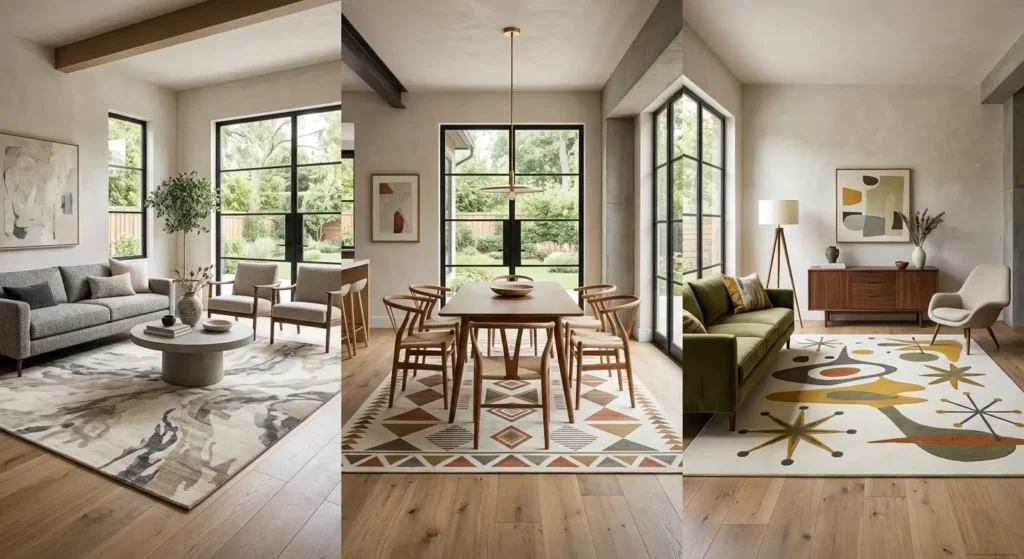
The first step to using any rug well is matching it to the room’s existing design language. Modern area rugs come in a wider range of styles than most people expect, and picking the wrong aesthetic — no matter how beautiful the rug itself — creates visual friction rather than harmony.
Contemporary abstract rugs work well in rooms that are already clean and minimal. Irregular shapes, watercolor-style blending, and asymmetric line work give these rugs an artistic quality without pulling attention away from the architecture of the space. They pair especially well with the kind of neutral-forward interiors explored in our minimalist living room decor ideas guide.
Geometric modern rugs are the most versatile option. Diamond grids, chevron patterns, and trellis designs are bold enough to anchor a room but structured enough to cooperate with furniture. They read as contemporary in almost any setting.
Mid century modern area rugs deserve special mention. This substyle draws on the design vocabulary of the 1950s and 60s — think starburst patterns, low-contrast color blocking, and organic shapes that echo Scandinavian and American modernist furniture. If your room features tapered wood legs, walnut tones, or classic case goods, a mid century modern area rug ties the whole look together more convincingly than almost any other design element. A mid century modern area rug with a warm oatmeal or terracotta base complements the earthy warmth explored in our warm minimalism living room ideas.
Flat-weave kilims and dhurries with modern colorways bridge traditional craft with contemporary interiors. They’re thin, lightweight, and ideal for layering — a technique covered in detail below.
When in doubt, start with the furniture. If the dominant shapes in your room are curved and soft, an abstract or organic-motif rug will feel natural. If the room is angular and structured, go geometric.
2. Get the Size Right — It Changes Everything
Rug size is where most decorating mistakes happen. A rug that’s too small makes furniture look like it’s floating on an island. A rug that’s too large overwhelms the space. Getting this right is less about personal preference and more about proportion.
The most common size used in living rooms, dining rooms, and primary bedrooms is the 8×10 modern area rug. At this size, an 8×10 modern area rug is large enough to anchor a full seating arrangement — front legs of the sofa and chairs sit on the rug, back legs off — creating a cohesive zone without carpeting the entire room. This is the standard recommendation interior designers follow for spaces between 12×15 and 16×20 feet.
For larger rooms, open-concept layouts, or dining areas where chairs need to stay on the rug even when pulled out, the 9×12 modern area rug is the more appropriate choice. A 9×12 modern area rug handles a full dining table with six to eight chairs comfortably and works in living rooms where the furniture grouping is deep or the space runs long. It’s also the right call for primary bedrooms with a king-size bed — the rug should extend at least 18–24 inches beyond each side of the bed.
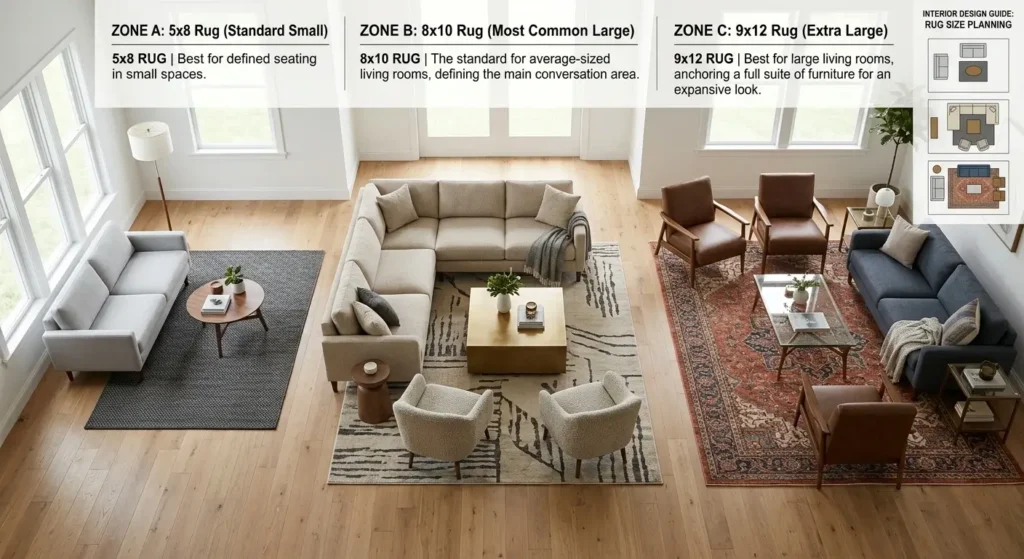
Area Rug Size Guide
| Room Size | Recommended Rug | Placement Rule |
|---|---|---|
| Small living room (under 12×14 ft) | 5×8 | Front legs on rug only |
| Medium living room (12×16 ft) | 8×10 | Front legs on rug |
| Large living room / open plan | 9×12 | All legs on rug |
| Dining room (6-seat table) | 8×10 minimum | Chairs stay on rug when pulled out |
| King bedroom | 9×12 | Extends 18–24″ on three sides of bed |
| Hallway / entryway | Runner (2.5×8 or 3×10) | Length covers main traffic path |
One commonly overlooked detail: always place a quality rug pad underneath. Beyond preventing slipping — which the Consumer Product Safety Commission identifies as a significant cause of home fall injuries — a pad extends the rug’s life by reducing friction against the subfloor and keeps the rug lying flat without bunching.
3. Transform Your Living Room with a Statement Rug
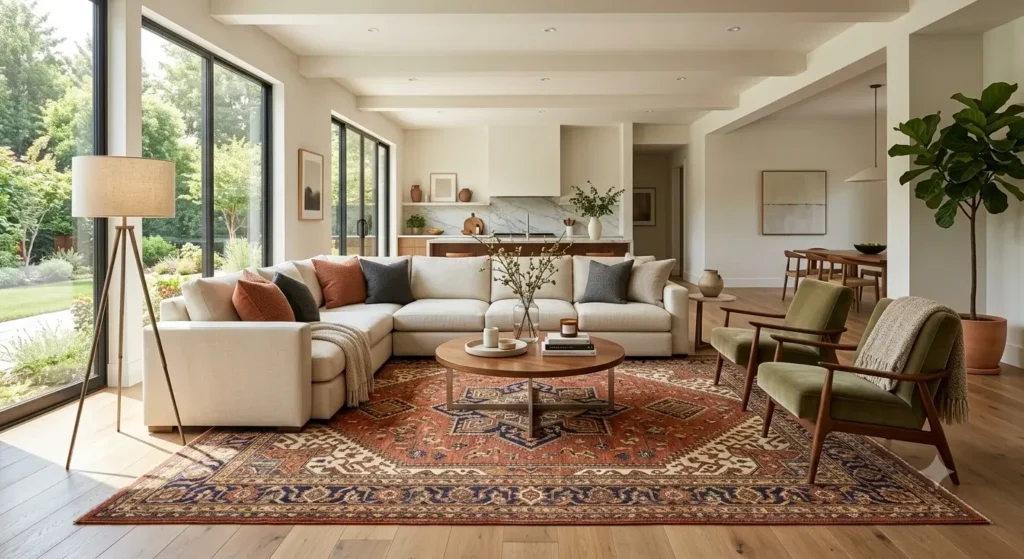
The living room is where a modern area rug does its most important work. It’s the room where people spend the most time, where traffic is highest, and where the floor surface is most visible. A well-placed large area rug doesn’t just decorate — it restructures the entire feel of the room.
Large modern area rugs for spacious living rooms should be treated as the visual foundation of the space, not an afterthought. Choose the rug first, then build the furniture arrangement around it. This approach, used by professional designers, prevents the all-too-common mistake of buying a rug that clashes with a sofa or conflicts with existing flooring tones.
In open-plan homes, a large living room rug defines the seating zone as a distinct space within a larger footprint — essentially creating a room-within-a-room. This is crucial when the living area flows into a dining space or kitchen without walls to separate them. Our living room design guide covers this zoning approach in detail, and a modern area rug is one of the primary tools that makes it work.
For spacious rooms, don’t be afraid of large area rugs that extend nearly wall to wall. A 10×14 or 12×16 in a genuinely large space reads as intentional and luxurious, not overwhelming. The key is maintaining at least 12–18 inches of bare floor visible around the perimeter.
In smaller living rooms, particularly in apartments, a single 5×8 or 6×9 centered under the coffee table creates the illusion of more space. This is the same principle behind many of the ideas in our modern living room decor ideas for small apartments guide.
4. Embrace the Power of Mid Century Modern Area Rugs
Mid century modern design has remained one of the most consistently popular interior styles for decades — and for good reason. It’s warm, human-scaled, and remarkably adaptable to contemporary living. The right mid century modern area rug amplifies all of those qualities.
Classic mid century modern area rug characteristics include:
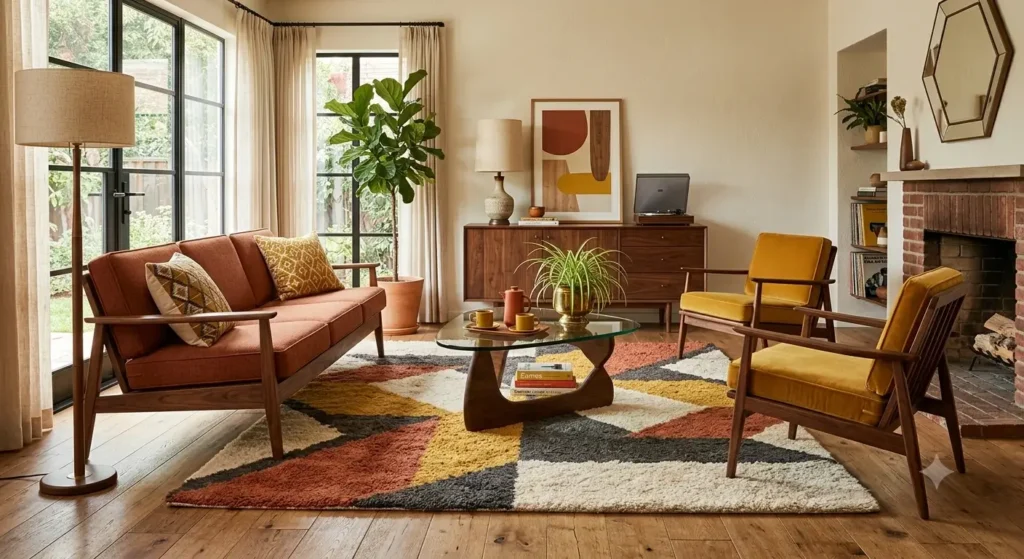
- Geometric motifs — starbursts, hexagons, diamonds, and atomic-age shapes
- Two- to three-color palettes — often combining warm neutrals (oatmeal, rust, mustard) with one cool or dark accent
- Low to medium pile — keeping the aesthetic clean and uncluttered
- Wool or wool-blend construction — which gives genuine mid century rugs their characteristic softness and resilience
A mid century modern area rug works best when it’s allowed to be the room’s focal point. Surround it with furniture that shares the aesthetic — tapered legs, natural wood, clean upholstery lines — and let it anchor the composition.
The colors in a mid century area rug should connect to at least two other elements in the room — a throw pillow, a lamp shade, an accent wall. This echo effect is what separates a well-styled room from one that feels like the rug was simply dropped in.
5. Use Color and Texture to Set the Mood
Color and texture are where modern area rugs move from functional to genuinely expressive. Both choices communicate something about the character of the space — and both have practical consequences worth understanding.
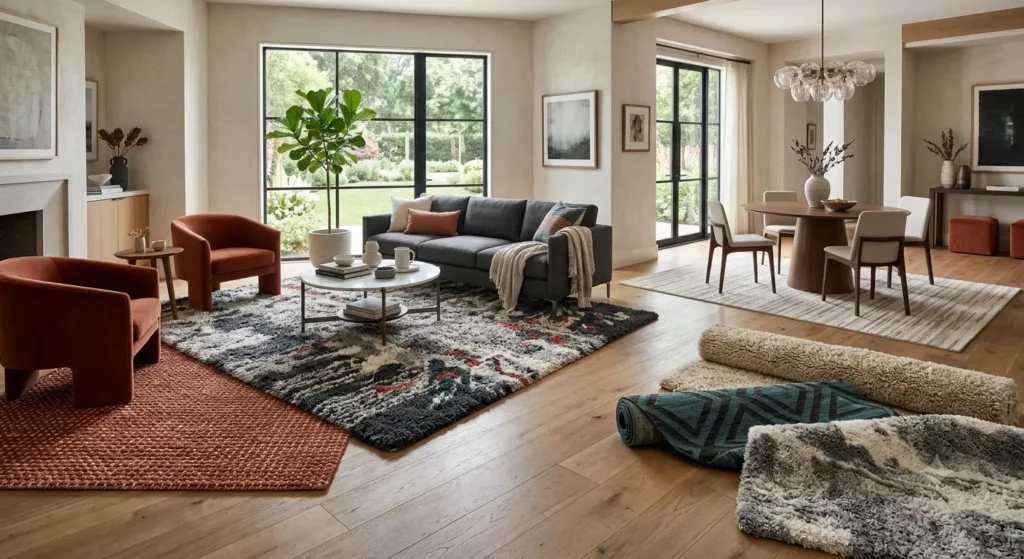
Color Strategy for Modern Rugs
Neutral modern rugs (ivory, beige, warm gray, charcoal) are the most forgiving choice. They work with nearly any furniture and adapt as the rest of the room changes. These are particularly effective in the kind of layered, texture-forward rooms featured in our modern home decor ideas for every home guide.
Bold-color modern rugs — deep teal, terracotta, forest green, cobalt — work best as intentional focal points in otherwise restrained rooms. The 60-30-10 color rule applies here: if the rug is the 10% accent, it should be the boldest color in the room.
Tonal rugs — where pattern and background share similar value but differ in hue — are one of the most sophisticated choices in modern interior design. They add visual interest without visual noise.
Area Rug Materials and Pile Height
| Pile Height | Feel & Performance | Best For |
|---|---|---|
| Low pile (under 0.5″) | Easy to clean, durable | High-traffic areas, under furniture |
| Medium pile (0.5–0.75″) | Soft, versatile | Living rooms, bedrooms |
| High pile / shag (over 0.75″) | Luxuriously soft, harder to maintain | Reading corners, low-traffic bedrooms |
From an indoor air quality standpoint, lower-pile rugs trap less particulate matter and are easier to clean thoroughly. The EPA’s guidance on indoor air quality notes that proper maintenance of soft floor coverings — including regular vacuuming and professional cleaning — contributes meaningfully to healthier indoor environments.
6. Layer Rugs for Depth and Personality
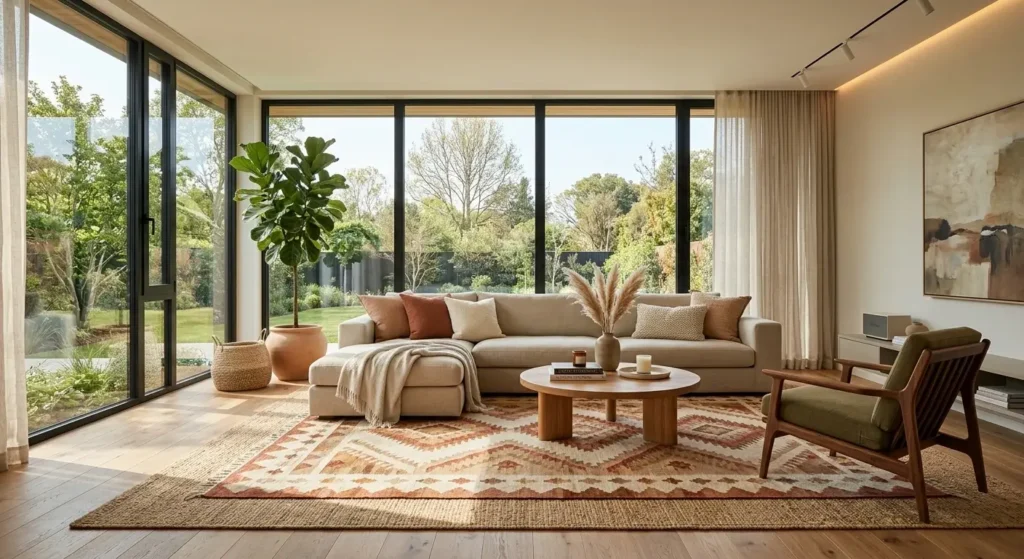
Learning how to layer rugs is one of the most effective and underused techniques in modern interior design. It involves placing one rug on top of another — typically a large, neutral base rug under a smaller, more textured or patterned one — to create depth, warmth, and visual complexity that a single rug cannot achieve.
The classic layering formula is a natural fiber base (jute, sisal, or seagrass in a large size) topped with a smaller modern area rug that has more personality. The natural base adds warmth and grounds the room, while the top rug introduces pattern, color, or texture. This is especially useful in rental situations where you can’t change the flooring.
Layering also solves sizing problems. If your room calls for a 9×12 but you’ve found a 6×9 mid century modern rug you love, a large jute base underneath solves the scale issue while adding richness.
In entryways, a small geometric or abstract modern rug layered over a natural runner creates a welcoming first impression. Our small entryway ideas guide explores this further — and a layered rug arrangement is one of the quickest transformations available.
7. Think Practically — Material, Maintenance, and Placement
The most beautiful modern area rug becomes a liability if it’s the wrong material for the space or maintained incorrectly. Practical considerations aren’t a footnote — they’re what separates a rug that still looks good in five years from one that needs replacing in one.
Choosing Area Rug Materials by Room
Living rooms and bedrooms: Wool and wool-blend rugs are the gold standard — naturally resilient, soft, and resistant to soil. Polypropylene (olefin) offers a budget-friendly alternative that performs reasonably well in moderate-traffic areas. Avoid viscose and bamboo silk in high-traffic zones; they look beautiful but crush and stain easily.
Dining rooms: Low-pile polypropylene or flatweave cotton rugs are easiest to clean after spills.
Traffic Flow and Placement
Modern area rugs should align with the natural movement paths in a room, not cut across them. In a hallway, the runner should run parallel to the length of the corridor with even margins on each side. In a living room, the rug should create a clear, unobstructed path from the entry point to the seating area.
Avoid placing rugs in ways that create trip hazards at thresholds — curling edges in high-foot-traffic areas are a common fall risk. The CPSC recommends ensuring rugs lie flat and are properly secured, particularly on hard-surface flooring.
Cleaning and Care
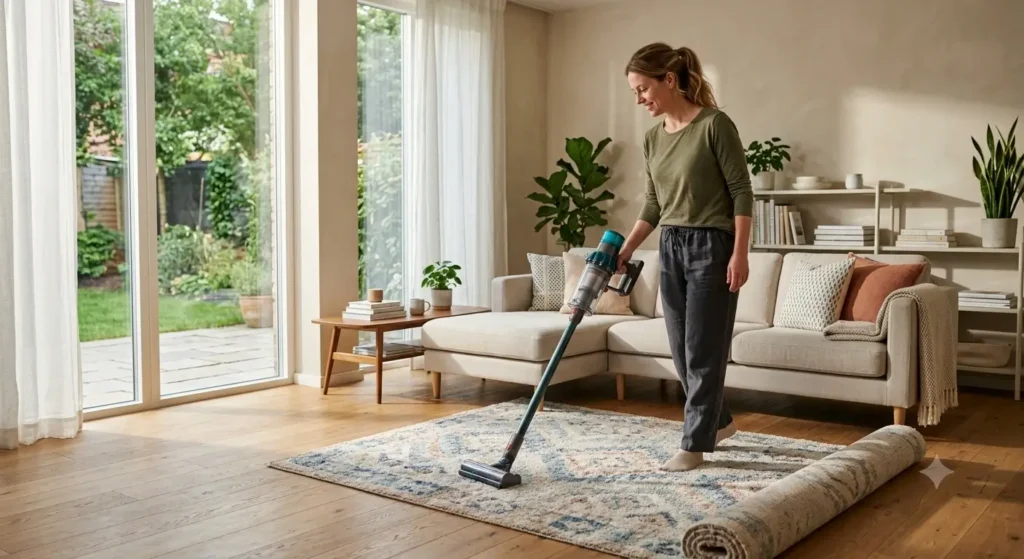
- Vacuum low-pile modern rugs at least once a week in high-traffic areas
- Use a suction-only vacuum on wool and natural fiber rugs — beater bars can damage fibers over time
- Rotate the rug 180 degrees every six months to equalize wear from foot traffic and sun exposure
- Professional cleaning every 12–18 months for quality natural fiber rugs
- Most budget polypropylene rugs can be hosed off outdoors and left to dry in sunlight
- Always check manufacturer care instructions before power washing
Key Takeaways
- Size first: An 8×10 modern area rug handles most living rooms; go 9×12 for larger spaces and dining areas
- Match the style to the room: Mid century modern area rugs work best with tapered-leg furniture and warm neutrals; contemporary abstract rugs suit clean, minimal interiors
- Use a rug pad: It prevents slipping, extends rug life, and is one of the most overlooked accessories in any room
- Material matters by room: Wool for living rooms and bedrooms; polypropylene or flatweave cotton for kitchens and dining rooms; machine-washable options for pet households
- Layering is a design tool: A large natural-fiber base under a smaller patterned rug solves sizing problems and adds depth
- Color strategy: Neutral rugs adapt over time; bold rugs work best as the intentional focal point of an otherwise restrained room
- Maintain regularly: Vacuum weekly in high-traffic areas, rotate every six months, and professionally clean natural fiber rugs annually
Frequently Asked Questions
What makes a rug “modern” in design terms?
Modern area rugs tend to feature clean lines, geometric or abstract patterns, and muted or intentional color palettes. They prioritize visual restraint over ornate detailing, making them compatible with a wide range of contemporary interior styles. Materials tend toward durability and ease of care — polypropylene, wool blends, and flatweave constructions are common.
How do I know if I need an 8×10 or a 9×12 modern area rug?
The choice comes down to room size and furniture layout. In a medium living room (roughly 12×15 to 14×18 feet), an 8×10 modern area rug works well with front furniture legs on the rug. For larger rooms, open-concept layouts, or dining areas with a six- to eight-seat table, a 9×12 modern area rug is the more appropriate scale. When in doubt, go up in size — a slightly large rug is far easier to work with than one that’s too small.
Can I use a modern area rug over carpet?
Yes. Choose a low-pile or flatweave modern rug — high-pile rugs layered over carpet become unstable underfoot. A rug pad designed for carpet-over-carpet use will keep the top rug from shifting.
What is a mid century modern area rug and where does it work best?
A mid century modern area rug draws on the design language of 1950s–1960s modernism: starburst patterns, atomic motifs, geometric shapes, and two-to-three-color palettes combining warm neutrals with bolder accents. These rugs work best in rooms with mid century furniture but also adapt well to contemporary rooms that want warmth and visual interest without a strictly retro look.
How often should I replace a modern area rug?
Quality wool or wool-blend modern area rugs, properly maintained, can last 20–30 years. Budget polypropylene rugs typically last 5–10 years with regular care. Key indicators for replacement are pile compression that doesn’t bounce back, permanent staining, backing deterioration, or significant fading.
Are modern area rugs safe for homes with children and pets?
Most modern area rugs made from synthetic fibers (polypropylene, nylon) are durable, non-toxic, and easy to clean — making them well-suited for active households. Look for rugs certified to low-VOC standards, as some adhesives and backing materials in lower-quality rugs can off-gas chemicals indoors. The EPA’s indoor air quality resources recommend choosing soft furnishings with low chemical emissions and maintaining them through regular cleaning.
What colors work best in a modern area rug for a living room?
For a room with colorful furniture or artwork, a neutral modern rug (warm gray, ivory, taupe) lets the other elements breathe. For a neutral room, a rug with one bold color — teal, terracotta, forest green — can serve as the room’s focal point. The safest approach is to pull from a color already present in the room — a throw pillow, a piece of art, the curtains — and find a rug that echoes it.
Conclusion
Modern area rugs are one of the few home furnishing decisions that affect how a room looks, sounds, and feels underfoot — all at once. The right rug grounds furniture, defines zones in open spaces, adds warmth to hard floors, and introduces color and pattern with a flexibility that paint or wallpaper simply can’t match.
The seven approaches covered here — from choosing the right style and size, to layering, to thinking practically about materials and maintenance — give you a framework for making confident decisions rather than guessing. Whether you’re anchoring a large living room with a 9×12 modern area rug, bringing mid century charm to a room full of tapered-leg furniture, or simply trying to make a small apartment feel finished and intentional, the principles are the same: start with scale, match the style to what’s already in the room, and choose materials that will hold up to how you actually live.
Looking for more decorating tips? Explore our Living Room Design Guide.
About the Author
Home Tweakz Team is a group of home improvement researchers, DIY enthusiasts, and interior design specialists dedicated to helping homeowners make informed decisions. Our content is carefully researched using industry best practices, expert recommendations, and trusted sources to provide practical, accurate, and actionable advice on home improvement, flooring, interior design, gardening, and home maintenance.
Website: HomeTweakz.com