
By Home Tweakz Team | Last Updated: 2026
Introduction
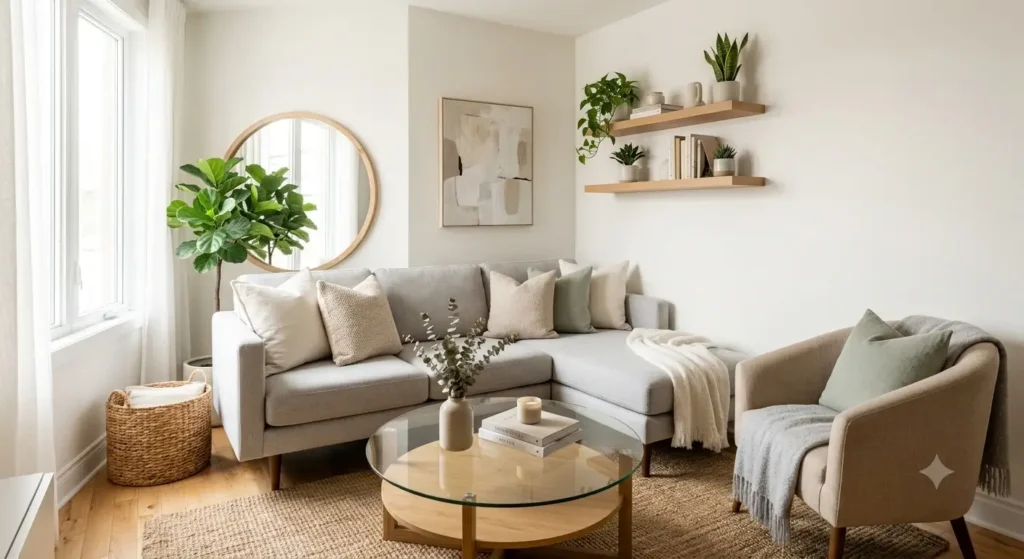
Living in a smaller home doesn’t mean you have to sacrifice comfort or style. In fact, some of the most beautiful, functional living rooms out there happen to be on the compact side. The secret isn’t magic — it’s smart furniture choices and space-saving living room furniture that truly fits your lifestyle.
When you’re working with limited square footage, every piece you bring in needs to earn its place. The right small living room furniture can open up a space, create flow, and give you everything you need without the clutter. The wrong choices, on the other hand, can make even a decent-sized room feel cramped and chaotic.
This guide walks you through everything you need to know — from choosing the right sofa and coffee table to laying out your furniture in a way that actually makes sense for the way you live. Whether you’re furnishing a studio apartment, a city condo, or a cozy starter home, these practical ideas will help you get the most out of every square foot, including small living room layout ideas you can test right away.
1. Understanding Small Living Room Requirements
1.1 The Importance of Space Management
Before you buy a single piece of furniture, you need to understand your space. That sounds obvious, but most people skip this step and end up with a sofa that’s too big or a coffee table that blocks every walking path in the room.
Space management in a small living room is about creating a layout where you can move freely, sit comfortably, and actually use the room the way it was meant to be used. A well-managed small space feels intentional. A poorly managed one just feels small.
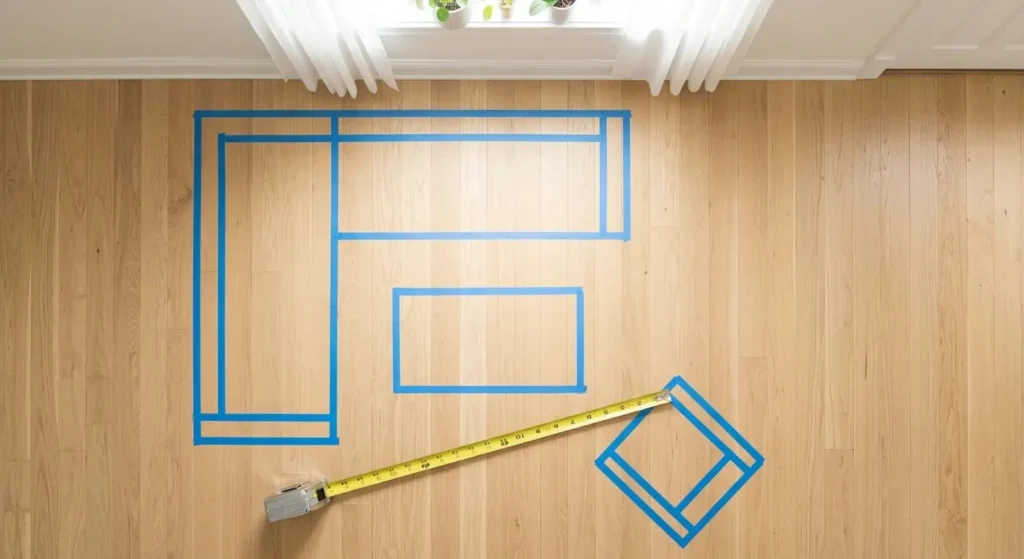
Start by measuring your room — not just the floor area, but also doorways, window placements, outlets, and any architectural features like radiators or built-in shelving. These details will guide every furniture decision you make. As you measure, keep a short list of small living room layout ideas to test so you can compare flow and clearance before buying anything.
There’s also a psychological side to this. Rooms that feel airy and uncluttered actually seem larger than they are. According to research from the U.S. Department of Housing and Urban Development, interior layout and furniture arrangement directly affect how livable and comfortable a space feels — especially in smaller homes and apartments. Thoughtful placement isn’t just aesthetic; it’s functional.
A good rule of thumb: leave at least 18 inches between seating and the coffee table, and aim for 30–36 inches of clearance on main walking paths. These numbers keep the room from feeling like an obstacle course.
If you’re starting from scratch with your living room design, our living room design guide covers the foundational principles that apply to rooms of all sizes. 1.2 Defining Comfy Furniture for Small Living Rooms
Here’s a common mistake: people assume that smaller furniture automatically equals comfy furniture for small living rooms. That’s not always true. A tiny loveseat that’s stiff and shallow is miserable to sit on, regardless of how much floor space it saves.
Comfort in a small space comes from choosing pieces that are appropriately scaled — not miniaturized versions of large furniture, but pieces designed with compact dimensions and real ergonomics in mind. Look for sofas with seat depths between 20–22 inches (deep enough to sit comfortably, shallow enough not to dominate the room), armchairs with clean profiles, and ottomans that can serve double duty as footrests and storage.
The goal is furniture that fits the room without fighting it.
2. Essential Small Living Room Furniture
Wait — sectionals in a small living room? Yes, but with one important condition: the right kind of sectional.
A standard large sectional will swallow a small room whole. But a compact L-shaped sectional — sometimes called a apartment-size sectional sofa or condo sectional — can actually work beautifully. It tucks into a corner, defines a seating zone, and gives you more seating capacity than a standard sofa without pushing into the middle of the room. These are classic examples of space-saving living room furniture when chosen in the right scale.
Look for sectionals with:
- A chaise that’s 60 inches or shorter on the long side
- Leg clearance underneath (this keeps the sofa visually light)
- Removable cushions for flexible configuration
A light-colored or neutral-toned sectional — cream, light gray, warm beige — will blend into the room rather than dominate it. Dark upholstery absorbs visual space; light upholstery reflects it.
If a sectional feels too risky for your dimensions, a classic two-seater sofa paired with a single accent chair gives you flexible seating without boxing yourself in. This combination works especially well if you need the room to feel open from the entryway.
Speaking of entryways — if your living room connects directly to a foyer, smart furniture placement near the entry matters just as much. Take a look at our small entryway ideas for inspiration on keeping that transition zone clean and functional. 2.2 Multi-Functional Coffee Tables
The coffee table is prime real estate in any living room. In a small one, it absolutely cannot be a single-purpose piece.
Multi-functional coffee tables are among the best investments you can make in living room furniture for small spaces. Here are the formats worth considering:
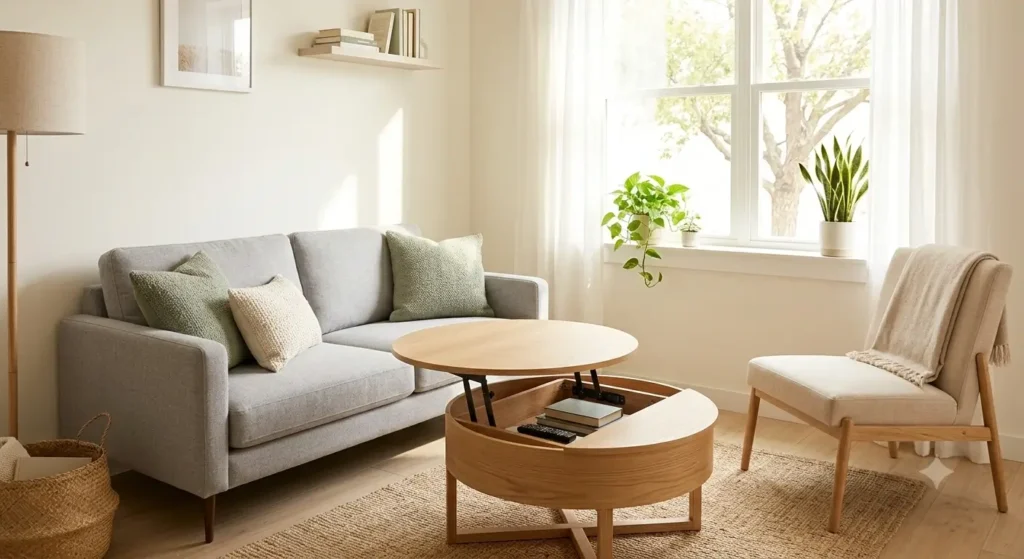
Lift-top coffee tables have a surface that raises to dining or laptop height — useful for eating, working from home, or doing a puzzle without hunching over. A compact lift-top coffee table with interior storage also keeps everyday items neatly out of sight.
Ottoman-style coffee tables with a tray on top give you soft seating, storage inside, and a surface for drinks or remotes. They’re also easier to move around when you need the floor space for guests, exercise, or kids.
Nesting tables are two or three tables of different sizes that stack together and pull apart as needed. When you only need one surface, they stay tucked. When you have people over, you spread them out.
Glass or acrylic coffee tables are worth mentioning here — they take up zero visual space because you can see straight through them. This is one of the simplest tricks for making a small room feel less crowded.
Whatever style you choose, keep the footprint proportional. A coffee table should be roughly two-thirds the length of your sofa and leave clear space for movement on all sides. 2.3 Accent Chairs with Smart Storage
An accent chair serves two roles in a small living room: it adds a seating option and it contributes to the visual design of the room. In a small space, you want it to do a third thing too — pull its weight functionally.
Chairs with built-in side pockets, under-seat storage, or a slim profile that tucks into corners are ideal. A slipper chair — armless, with a low, straight back — takes up less visual and physical space than a traditional club chair while still being genuinely comfortable.
Barrel chairs with storage footrests are another smart pairing. The chair itself is compact and rounded (which softens hard room angles), and the matching ottoman stores blankets or magazines you’d otherwise leave in a pile. If you need even more flexibility, pair your chair with a storage ottoman that can act as a footrest, extra seat, or quick-hide spot for remotes and chargers.
For the overall design direction, pieces that lean toward minimalist living room decor tend to work best in small spaces — clean lines, restrained details, and no unnecessary bulk.
3. Creative Layouts for Small Living Room Furniture
3.1 Designing a Small Living Room Furniture Layout
Layout is everything. You can have beautiful furniture and still end up with a room that doesn’t work if the arrangement is off. If you’re looking for small living room layout ideas, start here.
The most common small living room furniture layout mistake is pushing everything against the walls. It feels logical — like it’ll create more open space in the middle — but it usually makes the room feel hollow and disconnected. Pulling furniture slightly away from the walls and arranging it around a central focal point (usually a TV or fireplace) creates a more cohesive, intentional look.
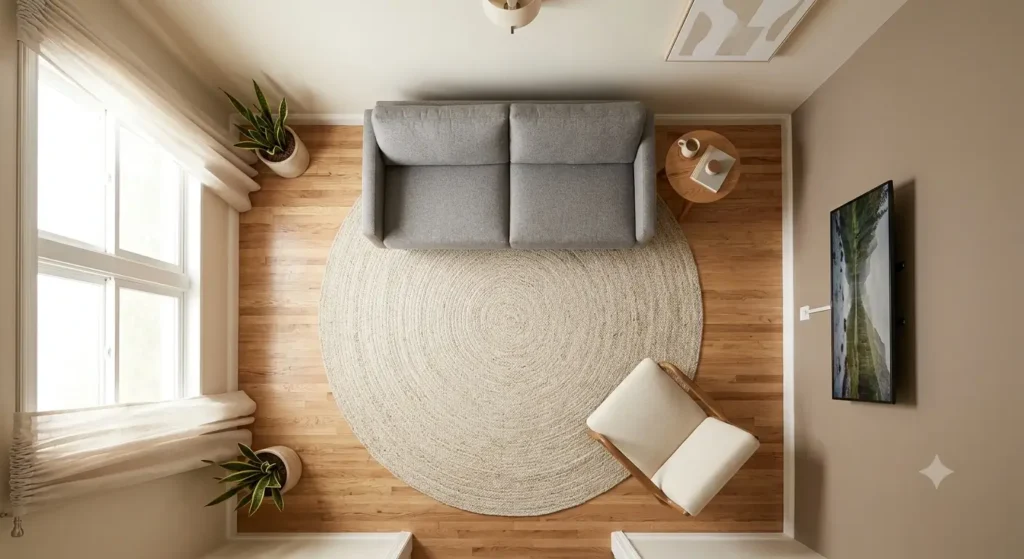
Here’s a layout approach that works well for most small rectangular living rooms:
| Furniture Piece | Placement Strategy |
|---|---|
| Sofa | Float 6–12 inches from the wall, facing the focal point |
| Coffee table | Centered in front of sofa, 18 inches of clearance |
| Accent chair | Angled at 45° toward both sofa and focal point |
| Side table | Tucked at sofa arm, accessible but not in a walkway |
| Console table | Against back wall or behind sofa for visual anchor |
This arrangement creates what designers call a conversation grouping — seating that faces each other at a human scale, making the room feel intentional and warm rather than like a waiting room.
For apartment-specific layouts and small-space design strategies, our modern living room decor ideas for small apartments covers this in depth. 3.2 Zoning Spaces within a Small Room
Sometimes a small living room needs to do more than one thing. It might also serve as a home office corner, a reading nook, or a dining area in a studio setup. In that case, zoning — creating distinct visual areas within a single open space — becomes critical.
Furniture itself is the best zoning tool. A sofa with its back to the rest of the room creates a natural divider. A bookcase placed perpendicular to the wall creates a visual boundary without blocking light. A well-placed area rug defines a seating zone without requiring walls or partitions.
A few zoning principles for small rooms:
- Use consistent flooring throughout (don’t try to zone with different flooring — it visually fragments small spaces)
- Choose area rugs that are large enough to anchor the seating zone (front legs of all seating on the rug, minimum)
- Keep zone furniture coordinated in style — mixing too many styles in a small space makes it feel chaotic
Our modern area rugs guide has solid advice on choosing the right rug size and style for compact living spaces.
4. Small Living Room Decor Ideas
4.1 Choosing the Right Color Palette
Color is one of the most powerful tools you have in a small living room, and it costs nothing if you’re just planning. If you’re exploring small living room color ideas, consider how natural light and lamp warmth will interact with your chosen tones throughout the day.
Light, neutral colors make walls recede and rooms feel larger. Off-white, warm beige, soft gray, and pale sage are all reliable choices for small spaces. That said, don’t feel like you have to stick to an all-white room — that approach can feel sterile and flat.
A better approach for small living room decor is the 60-30-10 rule:
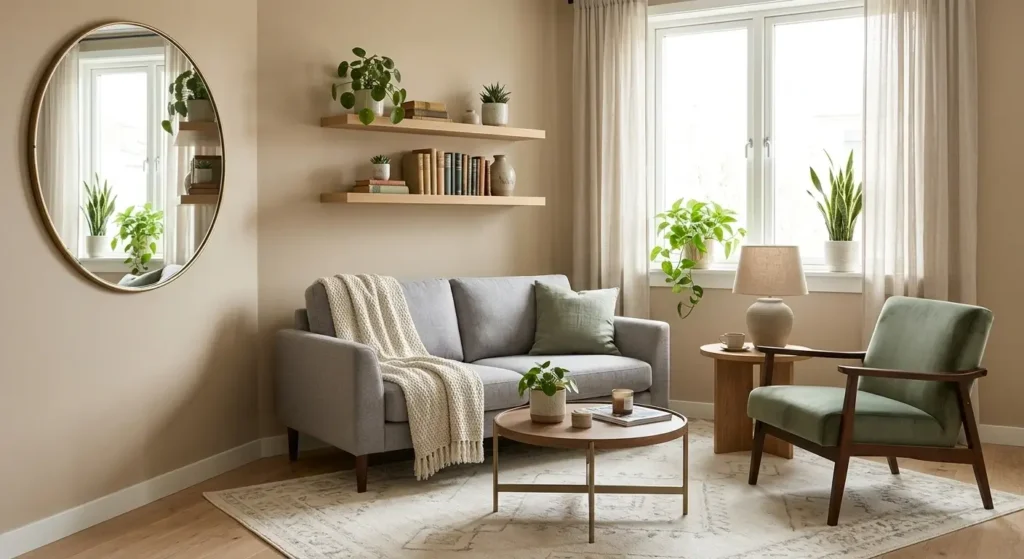
- 60% — your dominant neutral (walls, large sofa)
- 30% — a secondary tone (accent chair, drapes, rug)
- 10% — an accent color (throw pillows, artwork, a vase)
This creates visual depth and interest without overwhelming the room with pattern or color.
One often-overlooked trick: paint the ceiling a shade lighter than the walls. It visually raises the ceiling and makes the room breathe.
For a cozy, sophisticated take on small-space color, the warm minimalism living room ideas on HomeTweakz shows exactly how to layer neutrals with warmth and texture. 4.2 Incorporating Textures and Patterns
A small room with no texture looks flat. A small room with too much pattern looks busy. The goal is layered texture with restrained pattern.
Texture adds dimension — a woven throw on the sofa, a jute rug underfoot, linen curtains at the window, a wooden side table, a ceramic lamp. None of these are loud, but together they create a room that feels rich and lived-in.
Pattern works best when it’s used in smaller doses: a patterned throw pillow on an otherwise solid sofa, or a subtle geometric rug in a mostly neutral room. Avoid large-scale patterns on furniture in small rooms — they visually shrink the space.
Mirrors deserve a special mention here. A large mirror on one wall essentially doubles the visual depth of a room by reflecting it back. A leaning floor mirror in a corner, or a grouping of smaller mirrors, can transform how spacious a room feels without changing a single piece of furniture.
For large wall treatment ideas that work in compact rooms, our large wall decor ideas guide has practical options that scale down well.
5. Tips for Selecting and Arranging Furniture for Small Living Rooms
5.1 Measuring Your Space Effectively
This cannot be overstated: measure before you buy anything.
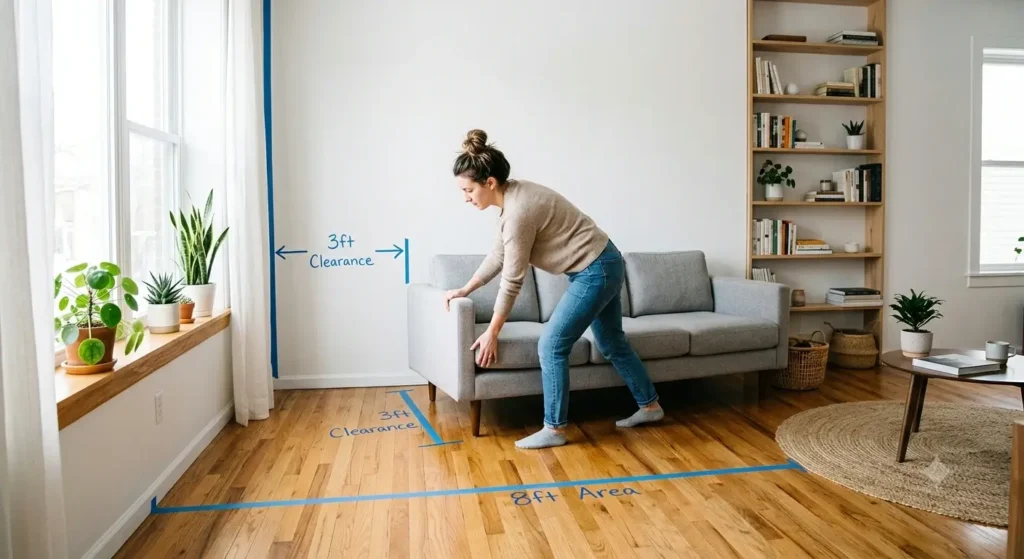
Take the full dimensions of your room — length, width, ceiling height. Measure doorways (you need to know if that sofa can actually get in). Note the location of outlets, vents, and light switches, since these often dictate where furniture can and cannot go.
Then, before ordering, tape out the furniture footprint on your floor using painter’s tape. This takes about five minutes and saves enormous amounts of frustration. A sofa that looks fine in a showroom can feel like a wall when you’re standing in your actual living room looking at a taped outline of it.
For rooms under 150 square feet, consider making a simple floor plan to scale — even a rough pencil sketch with accurate measurements lets you experiment with arrangements before committing.
General measurement guidelines for furniture for small living spaces:
| Recommended Clearance | Space |
|---|---|
| Main walking path | 30–36 inches |
| Sofa to coffee table | 15–18 inches |
| TV viewing distance | 1.5–2.5× the TV screen diagonal |
| Between two facing sofas | 3–4 feet |
| Sofa to wall (minimum) | 6 inches |
5.2 Utilizing Vertical Space and Avoiding Clutter
When floor space is limited, go up.
Tall bookshelves, wall-mounted shelving, and floating TV units all get storage and decor off the floor and onto the walls — which keeps the room feeling open at eye level. This is the core principle behind smart small-space interior design, and it works every time.
Wall-mounted shelving also lets you display items that would otherwise pile up on surfaces — books, plants, small art objects, candles — without eating into your floor plan. A pair of floating shelves flanking a TV can replace a bulky entertainment console entirely.
For more space-saving strategies across every room type, our small space interior design tips guide covers the principles that apply regardless of room type.
The other half of this equation is clutter control. In a small living room, clutter doesn’t just look messy — it physically shrinks the space. Everything that lives in the room should have a designated spot. Multi-functional furniture with hidden storage (the lift-top coffee table, the storage ottoman, the sofa with under-cushion drawers) makes this dramatically easier.
One practical system: the “visible tray” method. Keep one decorative tray on your coffee table or side table as the designated place for remotes, phones, small items. When the tray is full, nothing else stays out. Simple, but effective.
Key Takeaways
- Measure your room — including doorways and clearances — before purchasing any furniture.
- Choose multi-functional pieces: lift-top coffee tables, storage ottomans, and sofas with under-seat drawers maximize every square foot.
- Float furniture slightly away from walls rather than pushing it all to the perimeter — this creates a more cohesive, human-scaled arrangement.
- Use light, neutral colors for large surfaces, and add depth through texture rather than busy patterns.
- Go vertical with wall-mounted shelving and tall storage units to keep floor space open.
- Zone distinct areas within a small room using rugs, furniture placement, and consistent style — not walls or different flooring.
- A large mirror is one of the most effective (and affordable) ways to make a small living room feel significantly larger.
Q&A
1. How to arrange furniture in a small living room?
Answer: Arrange furniture around a focal point, maintain clear walking paths, and use compact furniture to maximize available space.
2. Can a sectional sofa work in a small living room?
Answer: Yes, a compact apartment-size sectional can provide ample seating while saving space when placed correctly.
3. How do I maximize space in a small living room?
Answer: Choose space-saving furniture, utilize vertical storage, and avoid overcrowding the room with oversized pieces.
4. Should I use a coffee table in a small living room?
Answer: Yes, but choose a compact or lift-top coffee table with storage to add functionality without taking up too much space.
5. What furniture makes a small living room look bigger?
Answer: Light-colored furniture, glass coffee tables, raised-leg sofas, and wall-mounted storage help create an open feel.
6. What is the best furniture layout for a small living room?
Answer: A layout with a sofa, coffee table, and accent chair arranged around a focal point creates balance and improves functionality
7. How to organize furniture in a small living room?
Answer: Use multi-functional furniture, hidden storage, and vertical shelving to keep the room organized and clutter-free.
Conclusion
A small living room isn’t a limitation — it’s a design challenge, and one that has very good solutions. With the best small living room furniture, the right layout, and a few smart decor choices, you can turn a compact space into a room that feels comfortable, put-together, and genuinely livable.
Start with your measurements, choose pieces that work harder than one job, and resist the urge to fill every inch. The rooms that feel most spacious are usually the ones with a little room left to breathe.
If you’re working on other areas of your home alongside the living room, our guides on small bedroom interior design ideas on a low budget and modern home decor ideas are worth exploring next.
Author Box
About the Author
Home Tweakz Team is a group of home improvement researchers, DIY enthusiasts, and interior design specialists dedicated to helping homeowners make informed decisions. Our content is carefully researched using industry best practices, expert recommendations, and trusted sources to provide practical, accurate, and actionable advice on home improvement, flooring, interior design, gardening, and home maintenance.
Website: HomeTweakz.com